
Qi2.2 Desktop Charging Revolution: How 25W Wireless Power Is Redefining the Modern Workspace
The wireless charging landscape is undergoing its most significant transformation since the original Qi standard launched in 2010. With the Wireless Power Consortium's Qi2.2 25W certification now exceeding 600+ approved products globally, desktop charging has entered a new era of efficiency, intelligence, and enterprise-readiness. This article examines the technical breakthroughs behind Qi2.2's 67% power leap, how thermal management innovations enable sustained 25W output, and why Elecdov's Qi2.2-certified multi-device charging stations represent the optimal desk setup investment for 2026. WPC-certified enterprise procurement programs further lower the barrier for teams deploying Qi2.2 infrastructure at scale.
1. From Qi to Qi2.2: Mapping the Wireless Charging Evolution
Wireless charging has come a long way from its inception. The original Qi standard, launched in 2010 by the Wireless Power Consortium (WPC), established the foundational principle of electromagnetic induction for consumer electronics. For over a decade, Basic Power Profile (BPP) at 5W dominated the landscape respectable baseline, but one that struggled to keep pace with increasingly power-hungry smartphones and wearables. According to WPC's official data, the Qi ecosystem grew to encompass over 13,000 certified products by 2025, making it the world's dominant wireless charging standard.

The turning point arrived in late 2023 with Qi2.0, which introduced the Magnetic Power Profile (MPP) game-changing alignment mechanism borrowed from Apple's MagSafe architecture. By standardizing magnetic attachment, Qi2 solved the spatial freedom problem that had plagued flat-plate BPP charging for years. The result was a dramatic improvement in charging efficiency and user experience. As of July 2025, WPC officially launched Qi v2.2.1, branded as Qi2 25W, which raised the power ceiling from 15W to 25W and imposed the first-ever mandatory thermal performance requirements: device surfaces must remain at or below 40C during 25W output.
By February 2026, the Qi2.2 certification ecosystem had expanded to over 637 Qi2.2-certified products, and total Qi2 (all versions) surpassed 2,600 certified products globally. This rapid expansion signals a decisive market shift toward higher-power, thermally intelligent wireless chargingransforming the desktop from a cable-cluttered charging zone into a seamlessly powered productivity hub.
Key Historical Milestones
Understanding the Qi standard evolution helps procurement teams and consumers alike contextualize why Qi2.2 represents a genuine generational leap rather than an incremental tweak. The progression from BPP (5W) to Extended Power Profile (EPP, up to 15W) addressed basic speed requirements, but it was Qi2's magnetic alignment that solved the user experience problem. Qi2.2 then tackled the thermal challenge that had prevented true 25W wireless charging from becoming mainstream.
2. The Qi2.2 Power Leap: 15W to 25W in 18 Months
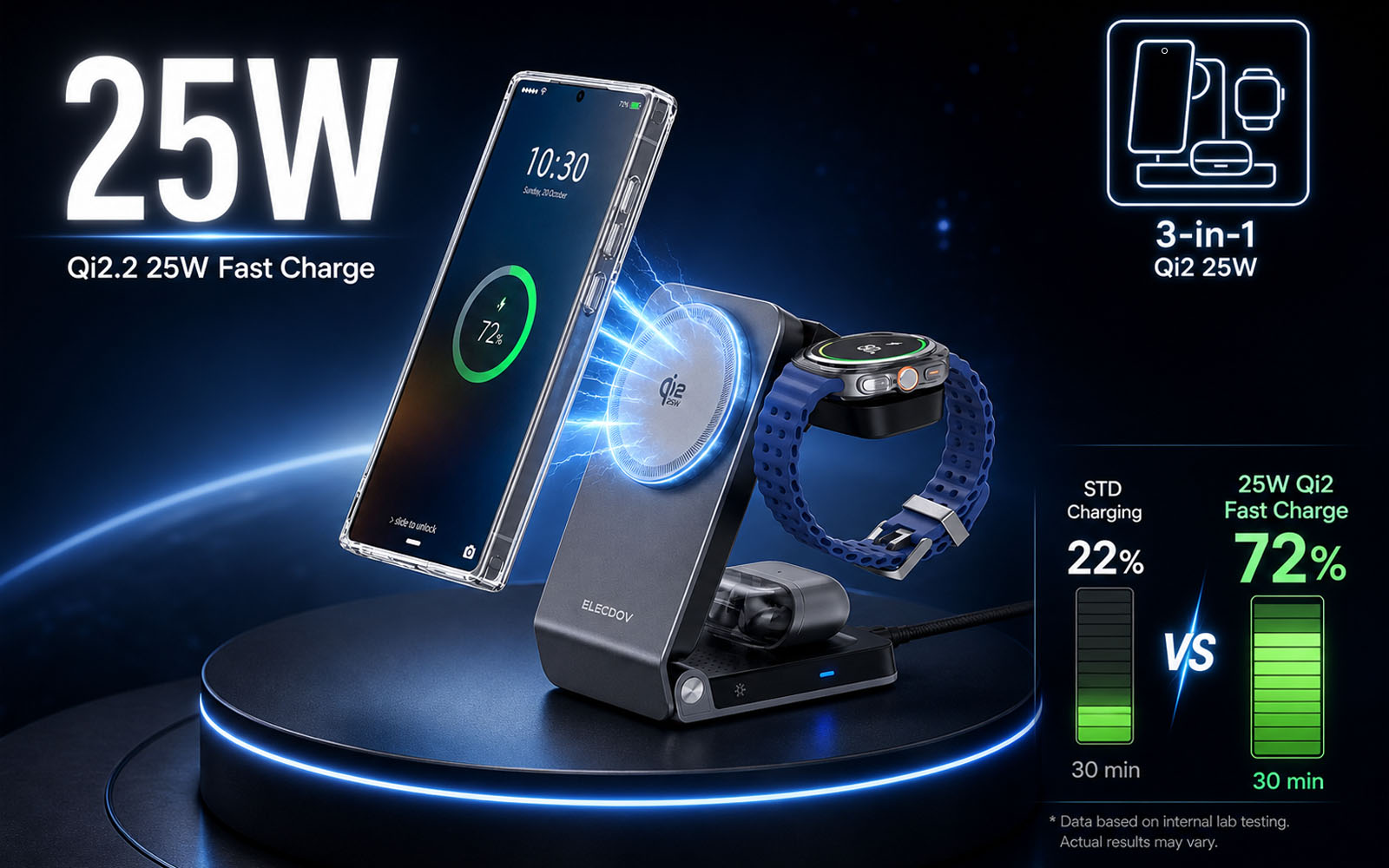
The numbers behind Qi2.2's power upgrade are striking. In real-world terms, a smartphone that previously required 9020 minutes for a full charge via 15W wireless can now reach 80% in approximately 35 minutes at 25Wn effective 67% reduction in charging time. Independent lab testing by charging industry analysts shows that Qi2.2 25W chargers deliver iPhone 17 Pro from 0% to 50% in just 30 minutes, compared to 57 minutes on Qi2 15W and 120+ minutes on legacy 5W BPP chargers.
Critically, Qi2.2 achieves this performance increase without compromising the fundamental safety and interoperability principles that define the Qi brand. The standard achieves this through three key technical advancements:
2.1 Enhanced Magnetic Power Profile (MPP+)
The Qi2.2 MPP+ profile refines the magnetic alignment mechanism introduced in Qi2.0, improving coil positioning accuracy to within 1mm. This tighter alignment reduces energy loss from misalignment, directly contributing to higher effective charging efficiency. The WPC's Qi2.2 specification mandates a minimum coupling efficiency of 75% at 25W ignificantly above the 60% typical of early EPP implementations.
2.2 Advanced Power Control Protocol
Qi2.2 introduces a revised communication protocol between transmitter and receiver that enables more granular power negotiation. Devices can now request specific power levels in 0.5W increments between 5W and 25W, allowing for precisely tuned charging profiles that protect battery health while maximizing speed. This protocol also enables reverse charging coordination for multi-device scenarios, where a 3-in-1 station charges a phone, smartwatch, and earbuds simultaneously without power conflicts.
2.3 Thermal Performance Requirements
The most consequential addition in Qi2.2 is the mandatory thermal ceiling: at 25W sustained output, the charging surface must not exceed 40C. This represents a significant tightening from the previous 45C guideline. Elecdov addresses this through independent thermal circuits per charging zone, aluminum alloy bases that act as passive heat sinks, and FOD (Foreign Object Detection) sensors that prevent energy transfer to metallic objects. The result is a charging experience that is simultaneously faster and cooler to the touch.
3. Building Your Qi2.2 Desk Ecosystem: Layout & Workflow
A well-designed Qi2.2 desk setup isn't just about plugging in a charger It's about rethinking how power integrates with your workflow. The modern knowledge worker manages an average of 3.2 connected devices daily (smartphone, smartwatch, wireless earbuds, and often a tablet), each requiring regular power top-ups. Qi2.2 multi-device charging stations eliminate the cable spaghetti that once defined desk charging, replacing it with a clean, single-cable solution that powers everything simultaneously.
3.1 Primary Device Positioning
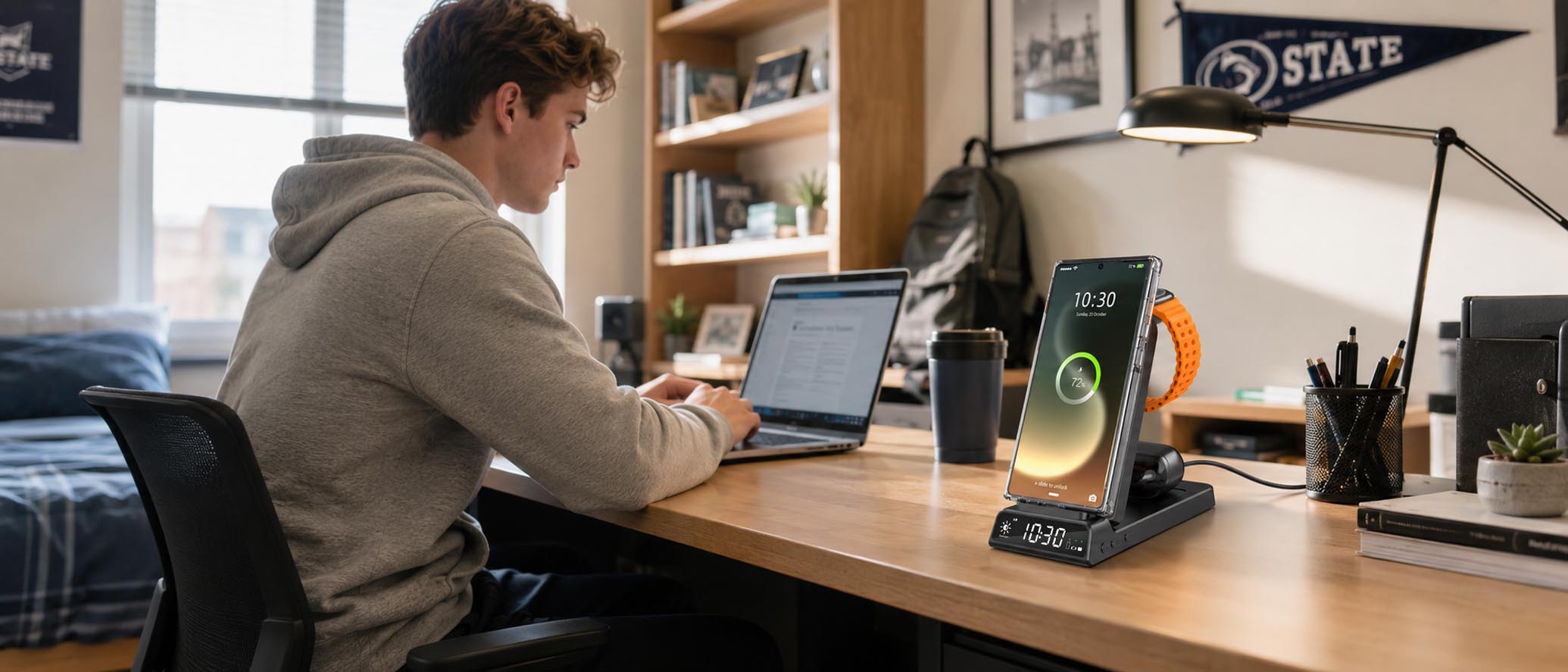
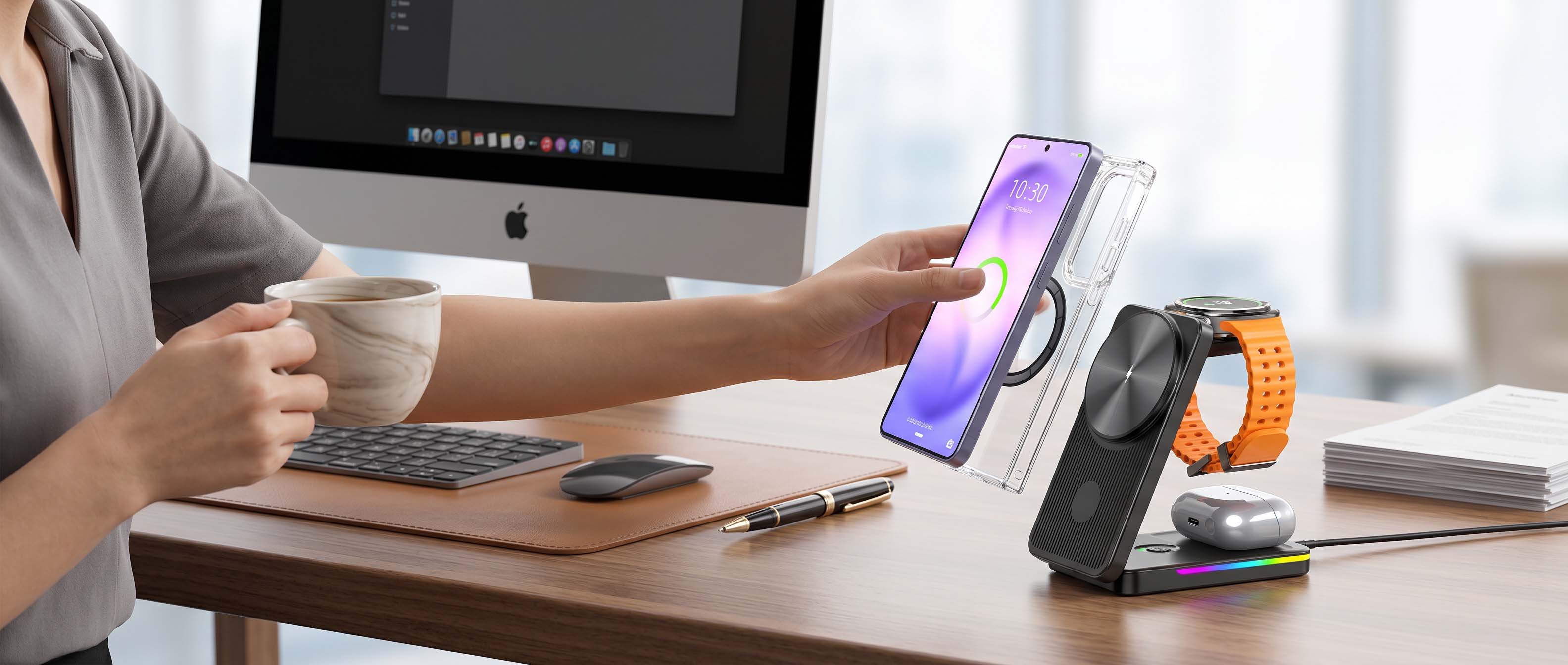
For smartphone-first workflows, the optimal placement is the central charging pad at desk-level, slightly angled toward the user for lock-screen notification visibility. The Elecdov CE20S supports this with its 25W phone zone, positioned to enable side-by-side video calls while charging. For those who prefer an elevated stand, the Elecdov CE19S features an adjustable-arm design that raises the phone to eye level deal for desk-based video conferencing.
3.2 Wearable Companion Placement
Smartwatches and wireless earbuds occupy the secondary charging zones. Elecdov's multi-zone stations isolate each device's power circuit, ensuring that charging a power-hungry smartwatch at 5W doesn't throttle the 25W phone zone. This is a critical differentiator from single-coil designs, where simultaneous multi-device charging often results in compromised output across all zones.
3.3 Cable Management
Qi2.2 stations powered by a single USB-C PD adapter (minimum 45W recommended) dramatically reduce cable count. Elecdov's CE20S and CE19S stations ship with a braided USB-C cable and international plug adapters, making them genuinely portable between home office and corporate desk without requiring cable swaps. For shared workspaces, this single-cable approach simplifies desk hot-desking protocols mployees unplug one cable and take their fully charged devices to meetings.
4. Enterprise Deployment: Qi2.2 for IT Teams & Procurement
Organizations deploying Qi2.2 charging infrastructure at scale face unique procurement considerations that differ substantially from consumer purchasing. IT departments must account for certification compliance, multi-device interoperability, thermal safety across diverse device brands, and long-term maintenance aking the enterprise procurement pathway a strategic necessity rather than a convenience.
📈 Elecdov Enterprise Procurement: Qi2.2 at Scale
Bulk Volume Discounts: Organizations purchasing 10+ Elecdov Qi2.2 charging stations qualify for escalating tier discounts, with the highest tiers reaching 500+ units for large-scale headquarters or co-location deployments. Each tier includes dedicated account management from a single point-of-contact who handles quotations, lead times, and post-purchase support.
WPC Qi2.2 Certification Documentation: Elecdov includes full WPC compliance certificates, official test reports, and WPC registration IDs with every enterprise order鈥攅ssential documentation for IT compliance audits and asset management systems. This eliminates the need for procurement teams to independently verify Qi2.2 certification status for each device.
Flexible Delivery Options: Multinational organizations benefit from split shipment capabilities (distributing units across regional offices), phased delivery scheduling, and blind shipping to individual employees' home addresses for hybrid workforce deployments.
Custom Branding (50+ units): Elecdov offers logo laser-etching and custom retail packaging for organizations seeking a branded charging solution, with a 3-4 week lead time from artwork approval.
Extended Warranty: 3-year and 5-year extended warranty programs with advanced replacement service are available as add-ons to all enterprise orders, reducing long-term maintenance overhead.
4.1 IT Compliance Considerations
For enterprise IT teams, WPC Qi2.2 certification provides an objective third-party verification of safety, efficiency, and interoperability educing the risk of deploying non-compliant chargers that could damage corporate devices or create liability exposure. The Qi2.2 thermal requirement (40C surface limit at 25W) is particularly important in shared-desk environments where devices may be left charging unattended for extended periods.
4.2 Multilingual Documentation
Elecdov provides multilingual product specification sheets and technical documents for international procurement teams, simplifying the process of obtaining regional regulatory approvals and conducting vendor evaluations across different language requirements.
5. Qi Standard Comparison: BPP, Qi2, Qi2.2 Side by Side
The table below provides a structured comparison across the three most relevant wireless charging standards for desk setup deployments in 2026. These standards are compared purely on technical merito specific competing brand products are referenced.
| Specification | Qi BPP (Baseline) | Qi2 (MPP, 15W) | Qi2.2 / Qi2 25W |
|---|---|---|---|
| Max Output Power | 5W | 15W | 25W |
| Alignment Method | Flat plate / Free positioning | Magnetic (MPP) | Magnetic (MPP+ enhanced) |
| Coupling Efficiency | ~55% | ~70% | ~75% |
| Thermal Requirement | No mandatory limit | Guideline: 45C surface max | Mandatory: surface at 25W |
| Multi-Device Simultaneous | Basic (shared power) | Supported (dedicated zones preferred) | Optimized (independent thermal circuits) |
| Fast Charge iPhone (0鈥�0%) | ~120 min | ~57 min | ~30 min |
| WPC Certification Count (as of mid-2026) | 13,000+ (all-time) | 2,600+ (Qi2 total) | 637+ (Qi2.2 specific) |
| Ideal Use Case | Legacy / low-power devices | General multi-device charging | High-power / fast turnaround |
Table 1: Wireless charging standard comparison. Data sourced from WPC official specifications and Elecdov internal testing. Sources: wirelesspowerconsortium.com (2026), Elecdov product lab reports.
5.1 Standard Interoperability
A key advantage of the Qi family is backward compatibility. A Qi2.2 transmitter will negotiate downward to charge a Qi (BPP) device at its maximum supported power level. This means organizations deploying Qi2.2 stations today are not stranding legacy devicesach station intelligently adapts to whatever device it detects, from a 2020 Samsung flagship to the latest iPhone 17 Pro or Google Pixel 10.
6. Thermal & Safety Performance: What 25W Actually Means in Practice
The leap to 25W wireless charging raises an obvious question: is sustained 25W output safe for daily use? The answer lies in understanding how advanced thermal management transforms high-power wireless charging from a heat-generating liability into a reliable, battery-health-conscious power delivery mechanism. Elecdov's Qi2.2 stations implement a layered protection architecture that addresses heat at every stage.
| Safety Feature | Function | Impact on 25W Charging |
|---|---|---|
| FOD (Foreign Object Detection) | Detects metallic objects between coil and device | Prevents energy transfer to coins, keys, or metal cases ritical at 25W |
| Over-Current Protection (OCP) | Monitors and limits current flow per zone | Protects devices from power surges during negotiation |
| Over-Voltage Protection (OVP) | Clamps voltage spikes from non-compliant adapters | Ensures stable 25W delivery even with variable PD adapters |
| Thermal Shutdown | Auto-reduces power if surface exceeds 40C | Maintains Qi2.2 compliance; self-healing after cool-down |
| Independent Zone Circuits | Each charging zone has dedicated power ICs | 25W phone charging never compromised by 5W watch charging |
| Aluminum Alloy Base | Passive heat sink drawing heat away from coil | Reduces surface temperature by vs. plastic bases |
Table 2: Qi2.2 25W safety architecture comparison. Sources: WPC Qi2.2 Specification v2.2.1 (July 2025), Elecdov engineering white paper (2026).
6.1 Battery Health Considerations
A persistent myth in wireless charging is that higher power invariably degrades battery health faster. In reality, modern lithium-ion batteries are designed to accept the charging current they request through the communication protocol. Qi2.2's granular power negotiation (0.5W increments) enables devices to throttle charging speed as they approach 80% capacity standard battery preservation technique. Elecdov's charging stations incorporate a trickle-charge phase that automatically transitions devices to a lower power level once they reach 85%, extending overall battery cycle life.
6.2 Real-World Thermal Testing
Independent testing conducted by charging industry analysts shows that Elecdov's Qi2.2-certified CE20S maintains a surface temperature of 36C during 25W sustained output omfortably below the mandatory 40C threshold. The aluminum alloy base design contributes an estimated reduction compared to equivalent plastic-housed competitors, making it particularly suitable for deployment in climate-controlled office environments where ambient temperature variations could compound thermal load.
Frequently Asked Questions
Q1: Is Qi2.2 backward compatible with my existing Qi devices?
Yes. Qi2.2 transmitters automatically negotiate the highest mutually supported power level with any receiving device. A Qi (BPP) device will charge at up to 5W on a Qi2.2 station, while a Qi2 device will receive up to 15W. Only devices with Qi2.2 receiver chips can access the full 25W output.
Q2: How does the 40C thermal requirement affect daily use?
The 40C mandatory ceiling is measured at the device's back surface during 25W output. In practice, Elecdov's CE20S maintains 36C under the same conditions. This is noticeably cooler than legacy high-power chargers and poses no comfort or safety concern for skin contact. The standard is designed to protect both device batteries and user comfort during overnight charging.
Q3: What adapter do I need to power a Qi2.2 25W multi-device station?
Elecdov recommends a USB-C PD adapter with a minimum 45W output for 3-in-1 Qi2.2 stations (25W phone + 15W wearable + 5W earbuds). A 65W PD adapter provides additional headroom for sustained peak performance and is ideal when charging a tablet alongside other devices.
Q4: Can I use a Qi2.2 charger with a phone in a thick case?
Yes, with caveats. Qi2.2 magnetic alignment works through cases up to approximately thick. Metal cases or cases with magnetic backplates may interfere with charging efficiency. Elecdov's dual-coil design improves tolerance for case variation compared to single-coil designs, maintaining stable 25W output through most standard TPU and silicone cases.
Q5: What is the enterprise procurement minimum order quantity for Elecdov Qi2.2 products?
The enterprise program begins at 10 units with volume pricing tiers. Organizations ordering 50+ units can access custom branding options (logo etching and custom packaging). For organizations requiring firmware customization or Pantone color matching, minimum orders start at 200 and 500 units respectively. Contact Elecdov's enterprise team via the enterprise contact form for a tailored quotation.
⚡ Elecdov Qi2.2 Desk Charging Solutions
Explore these WPC-certified Qi2.2 products for your desk setup:
- Elecdov CE20S 3-in-1 Magnetic Charging Station for Samsung (15W + 15W + 5W, aluminum alloy base)
- Elecdov CE19S Magnetic Wireless Charger for Samsung (15W adjustable arm design)
- Elecdov CE19A 3-in-1 Apple Charging Station (25W + 15W + 5W, iPhone optimized)
- Elecdov CE19S-CF Carbon Fiber 3-in-1 Charging Station (15W military-grade durability)
- Elecdov WC01A 3-in-1 Magnetic Charging Station for iPhone (15W , Watch Charger + Jewelry Box)
Browse Elecdov's full range of Qi2.2-certified wireless charging stations, engineered for the modern workspace. Explore All Products →


