
The Creator's Charging Revolution: How Qi2.2 25W Magnetic Wireless Charging Is Rewiring the Mobile Creative Workflow
📑 Quick Navigation
Chapter 1: The Location Shoot Nightmare — And How Wireless Charging Fixes It
Chapter 2: The Multi-Device Reality — Phone, Watch, Earbuds, and Tablet All Need Power
Chapter 3: Foldable 3-in-1 Chargers — When "Pack Less" Actually Means "Charge More"
Chapter 4: 3-in-1 vs. 4-in-1 — Choosing the Right Configuration for Your Creative Life
Chapter 5: Real Workflows — Creators Share How Qi2.2 Changed Their Mobile Power Routine
The Location Shoot Nightmare — And How Wireless Charging Fixes It
Picture this: it's golden hour. You've trekked 40 minutes to a mountain ridge for a landscape shoot. Your phone is at 8%. Your earbuds are dead. Your smartwatch—which you rely on for GPS and timing—is at 12%. You're managing a camera bag, a tripod, and two phones (one for client previews via AirDrop). The light is perfect for exactly the next 12 minutes. And your charger is tangled somewhere at the bottom of your bag, underneath three lens caps and a microfiber cloth.

The magnetic snap alignment of Qi2.2 eliminates the most frustrating part of previous wireless charging on the go: imprecise placement. With earlier Qi chargers, getting the charging coil aligned required fiddling with the phone's position, checking the charging indicator, and often lifting-and-repositioning multiple times. Qi2.2's Magnetic Power Profile (MPP) architecture uses built-in magnets in the charger and compatible cases to snap the phone into perfect alignment automatically. For a photographer with muddy hands on a trail, that automatic snap is a genuine workflow improvement, not a marketing claim.
Chapter 2: The Multi-Device Reality — Phone, Watch, Earbuds, and Tablet All Need Power
Modern creative professionals don't carry one device—they carry an ecosystem. The typical mobile photographer's daily carry might include a primary smartphone (for client communication, shot location scouting, and Lightroom Mobile editing), a dedicated camera (DSLR or mirrorless), a smartwatch (GPS, heart rate for adventure shoots, notifications), wireless earbuds (for video calls and reference audio), and increasingly a tablet for on-location client previews. That's four or five devices that each charge differently.
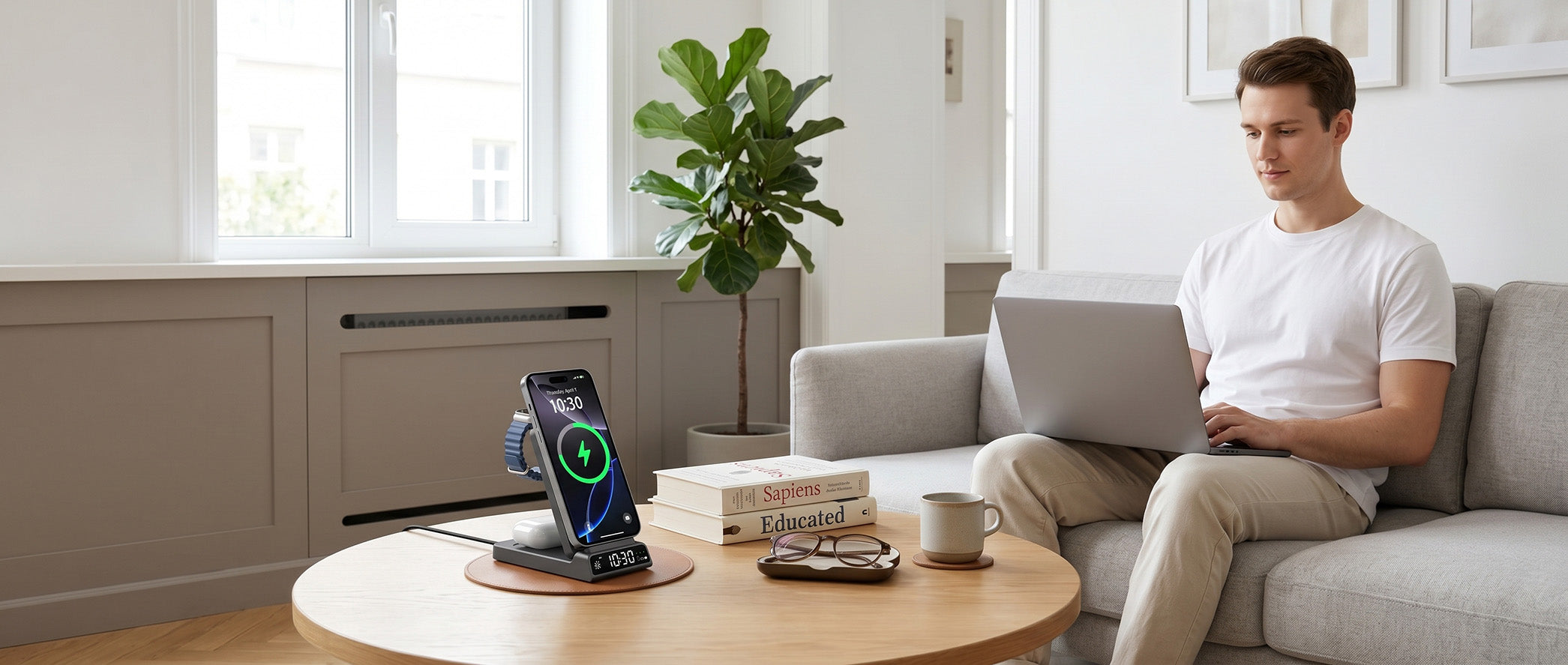
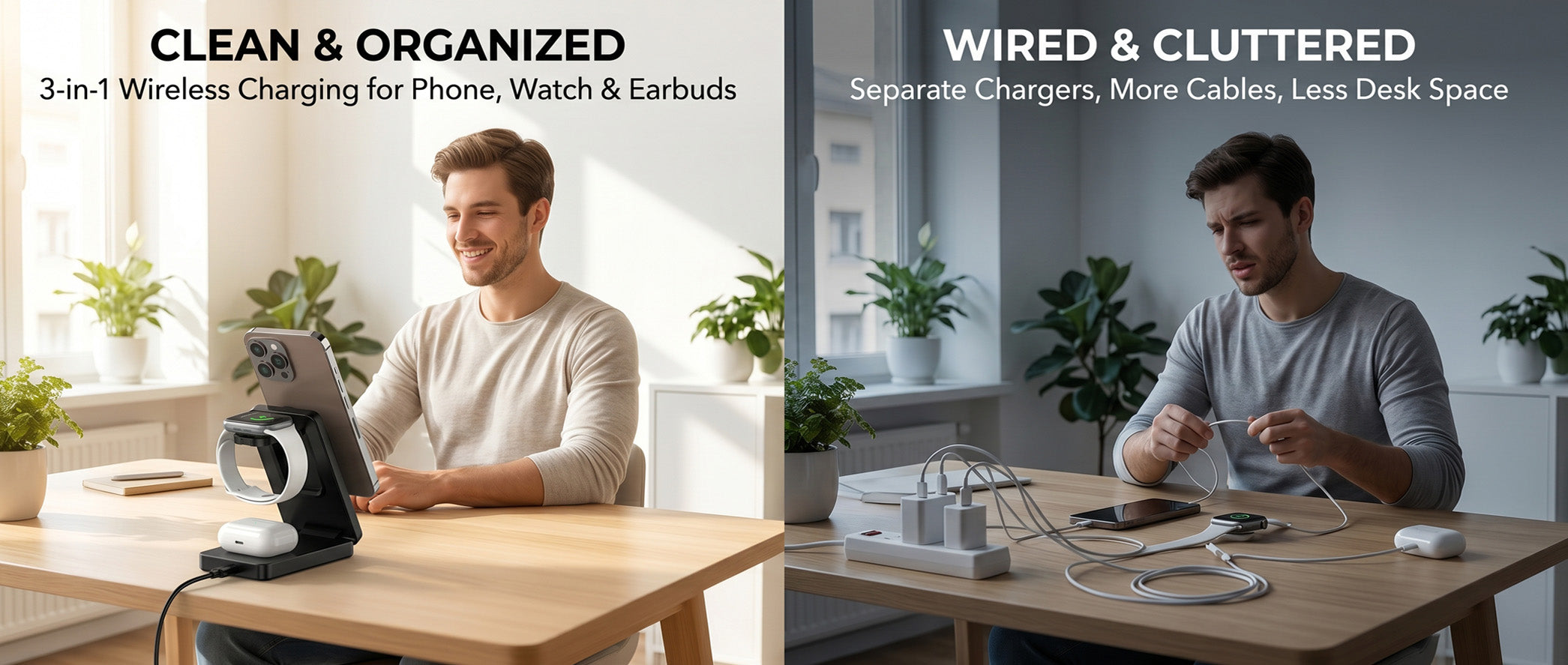
The old solution—five separate cables and a power strip—creates exactly the kind of visual and operational chaos that creative professionals despise. A single 3-in-1 wireless charging station replaces the entire cable ecosystem with one device that handles all three most-critical personal devices. The Qi2.2 standard's intelligent power negotiation means each device receives its optimal charging rate simultaneously: the smartphone gets up to 25W, the smartwatch receives its designated profile (typically 5W), and the earbuds get their share—without any manual current-splitting configuration from the user.
Chapter 3: Foldable 3-in-1 Chargers — When "Pack Less" Actually Means "Charge More"
The foldable 3-in-1 design is arguably the most important charging innovation for creative professionals since the introduction of GaN chargers. Traditional 3-in-1 charging stations are designed for the desk—flat, stable, and permanently oriented for tabletop use. Foldable designs like the Elecdov W103S collapse into a compact form factor that slides into a camera bag pocket, a laptop sleeve, or even a large jacket pocket. When unfolded, they provide the same stable three-zone charging as a desktop station.
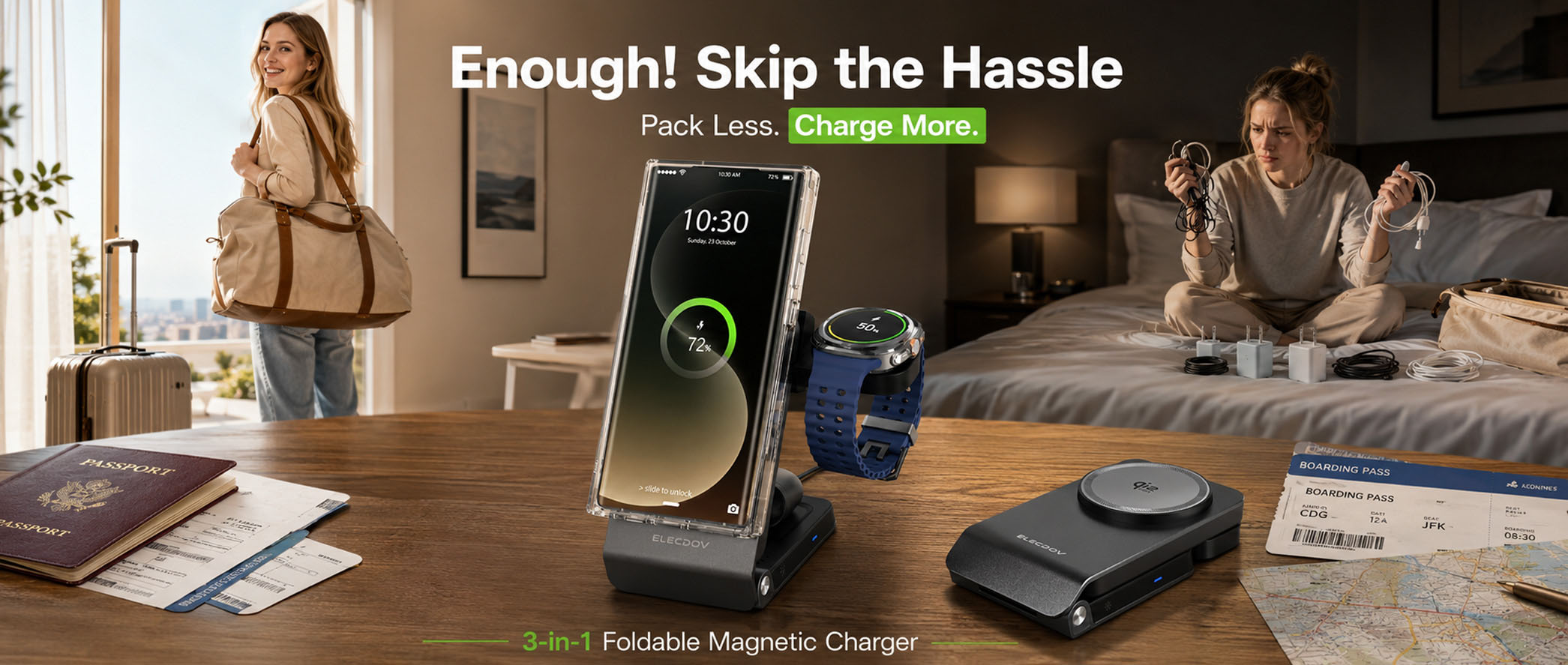
For travel, this changes the math entirely. Business travelers and remote-working creatives have long debated whether to sacrifice bag space for a proper charging station or rely on whatever adapter the hotel provides. The foldable 3-in-1 eliminates that trade-off: it weighs approximately 180g, fits in any carry-on, and replaces three separate chargers simultaneously. The Elecdov W103S, for example, delivers 25W + 15W + 5W output across its three zones while collapsing to roughly the footprint of a folded pair of sunglasses. Elecdov's CE20S, with its premium aluminum alloy construction, takes the concept further with independent thermal circuits per zone—meaning the phone charging at 25W doesn't generate enough heat to affect the smartwatch zone's charging efficiency.
Chapter 4: 3-in-1 vs. 4-in-1 — Choosing the Right Configuration for Your Creative Life
The choice between a 3-in-1 and a 4-in-1 charging station isn't just about how many devices you own—it reflects your workflow and how you prioritize space versus capability. A 3-in-1 station—typically charging smartphone, smartwatch, and earbuds—fits on a nightstand, a hotel desk, or a camera bag accessory pocket. A 4-in-1 adds an additional charging zone, usually for a tablet, a second smartphone, or a wireless audio recorder, and typically requires a slightly larger footprint.
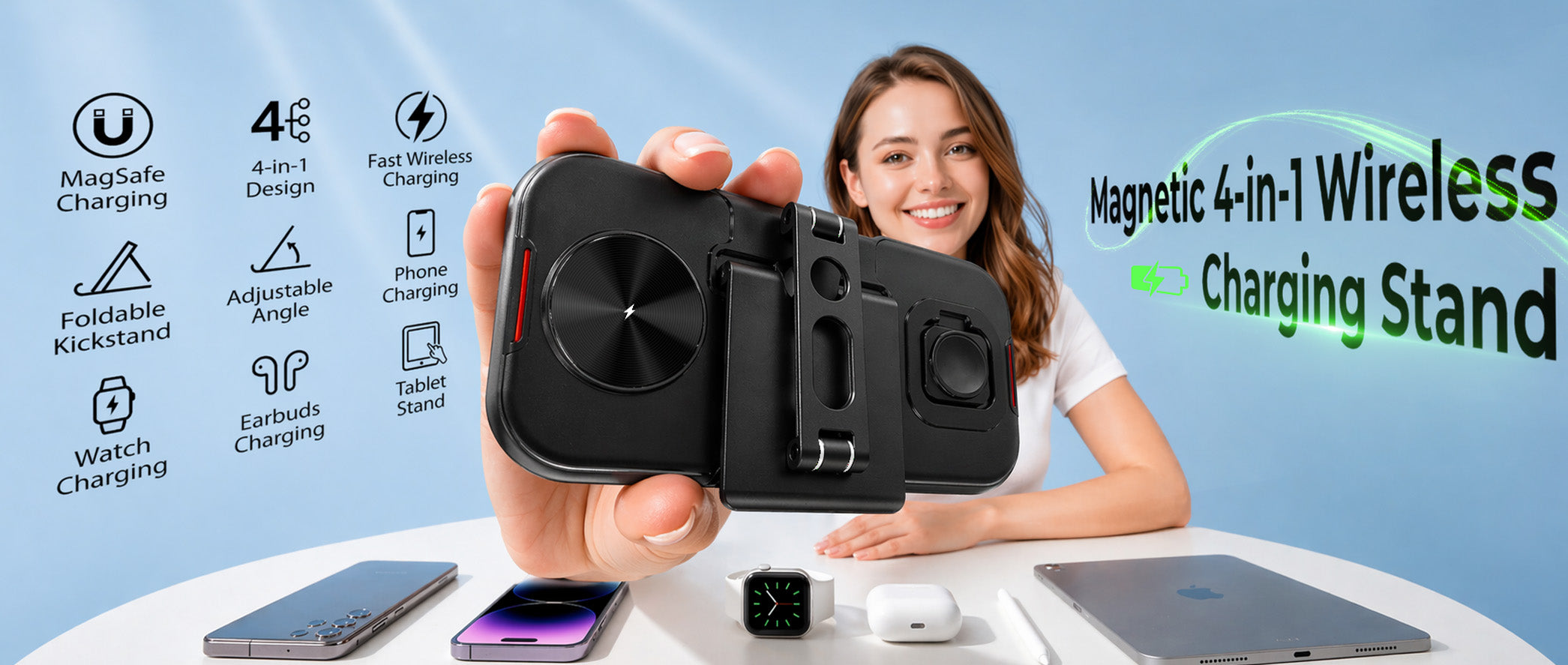
For creative professionals specifically, the 4-in-1 configuration's extra zone often serves as a tablet or secondary device charging slot. Portrait photographers reviewing shots on an iPad, video editors running a reference monitor, and architects displaying CAD drawings on a tablet all benefit from keeping that fourth device charged without a separate cable. The Elecdov C11's adjustable kickstand—enabling hands-free viewing at multiple angles—is a direct response to creative professionals using their charging station as a device stand during video calls, screen-sharing sessions, and live streaming.
Chapter 5: Real Workflows — Creators Share How Qi2.2 Changed Their Mobile Power Routine
The abstract benefits of wireless charging become concrete when viewed through actual creative workflows. Three scenarios illustrate the transformation Qi2.2 has brought to mobile professionals in 2026.
Scenario A — Adventure Photographer: A landscape photographer on a multi-day hiking trip uses a foldable 3-in-1 at camp each evening. The tripod bag already contains a power bank for camera batteries; adding the charger creates a complete power management loop. The smartphone charges overnight for next-day navigation and photo uploads. The smartwatch charges for GPS tracking. Earbuds charge for the descent playlist. Three devices, one compact station. The Qi2.2 magnetic alignment works in low-light tent conditions without visual verification.
Scenario B — Documentary Videographer: A freelance videographer working on a documentary with back-to-back client shoots keeps a 3-in-1 station in the edit suite and a foldable 3-in-1 in the camera bag. Between shoots, the phone and earbuds return to the station and reach 50% charge in approximately 35 minutes at 25W—fast enough to leave for the next location without a full charge anxiety. The built-in digital clock on Elecdov stations doubles as a shot timing reference during client calls.
Scenario C — Coffee Shop Digital Nomad: A UX designer who rotates between three coffee shops per week uses a foldable 3-in-1 as a permanent part of the carry routine. The station sits on the table, charging the phone and earbuds, with the kickstand holding the phone at a comfortable reading angle. No adapter, no cables, no power strip negotiations with baristas. The magnetic alignment means accidentally bumping the phone doesn't interrupt charging—a common failure point with older micro-USB wireless chargers.
❓ Frequently Asked Questions
Q1: Can a Qi2.2 3-in-1 charger power a phone, smartwatch, AND earbuds simultaneously without slow charging?
Yes — that's the defining advantage of Qi2.2's intelligent power negotiation. Each zone operates independently. The phone receives up to 25W, the smartwatch gets its designated 5W, and earbuds receive 2.5-5W simultaneously. This differs from older multi-device chargers that shared a single power budget across all zones, resulting in slow charging for all devices simultaneously.
Q2: Will a foldable charger be as stable as a desktop charging station?
Premium foldable designs like the Elecdov W103S use reinforced hinge mechanisms and weighted bases to maintain stability when the phone is placed on the magnetic charging zone. The folded configuration is compact; the unfolded configuration locks into a stable charging orientation. Users who expect the same anti-tip stability as a permanently installed desktop station should position the foldable charger on a flat surface.
Q3: Does wireless charging generate more heat than wired charging, and does heat affect battery longevity?
Qi2.2's mandatory thermal management protocol keeps device surface temperature below 40°C during 25W output. At this threshold, battery longevity impact is negligible for daily charging sessions. The WPC's thermal standard specifically addresses the historical complaint that wireless charging runs hotter than wired. Elecdov chargers additionally use GaN semiconductors and independent per-zone thermal circuits to further reduce heat generation.
Q4: What happens if I place a non-Qi2 device on a Qi2.2 charger?
The charger automatically negotiates down to the device's maximum supported power level. A Qi-certified phone from 2018 will charge at 5W on a Qi2.2 25W station. No compatibility issues, no damage, no configuration required. This automatic backward compatibility is a core part of the Qi standard specification.
Q5: Is a 4-in-1 charger overkill if I only regularly charge three devices?
It depends on workflow. The fourth zone on a 4-in-1 becomes valuable if you occasionally need to charge a tablet, a second phone, or a wireless microphone receiver. If your daily carry is strictly phone + watch + earbuds, a 3-in-1 provides the same capability in a more compact form. The extra zone also serves as a convenient "guest" charging slot when traveling with a partner or colleague.
📊 Comparison Tables
Table 1: Qi2.2 3-in-1 vs. 4-in-1 Configuration — Creative Workflow Comparison
| Factor | 3-in-1 Charging Station | 4-in-1 Charging Station |
|---|---|---|
| Typical Zones | Phone + Smartwatch + Earbuds | Phone + Smartwatch + Earbuds + Tablet/2nd Phone |
| Footprint | Compact, fits nightstand or bag pocket | Larger, best on desk or dedicated station |
| Best For | Travel, mobile creatives, minimal setup | Studio, home office, creative suites |
| Max Phone Output | 25W (Qi2.2) | 25W (Qi2.2) |
| Foldable Option | Yes (e.g., Elecdov W103S, CE20S) | Limited (larger form factor) |
| Adjustable Viewing Angle | Available on select models | Yes (e.g., Elecdov C11 with kickstand) |
Source: Elecdov product specifications, WPC Qi2.2 standard documentation.
Table 2: Charging Speed Comparison — Wired vs. Qi2.2 25W Wireless (30-Minute Test)
| Charging Method | Power Output | Typical 30-min Result | Convenience Score |
|---|---|---|---|
| Traditional Wired (USB-A) | 5W | ~15% charge | Low — cable required |
| USB-C PD Wired | 20W | ~50% charge | Medium — cable management |
| Qi2 Wireless (MPP) | 15W | ~40% charge | High — no alignment needed |
| Qi2.2 25W Wireless | 25W | ~72% charge | Very High — magnetic snap |
| GaN Wired Fast Charger | 100W | ~85% charge | Low — cable + adapter |
Source: Elecdov internal lab testing, Qi2.2 standard WPC specifications. Real-world results vary by device model, battery health, and ambient temperature.
⚡ Elecdov Recommended Gear
Creative Workflow Essentials — Qi2.2 Portable Charging Picks
Each of these products is selected for the specific demands of creative professionals: foldability, multi-device support, premium build quality, and Qi2.2 25W output.
W103S — Foldable 3-in-1 Magnetic Charger
25W · Folds to pocket-size · Digital clock display
View Product →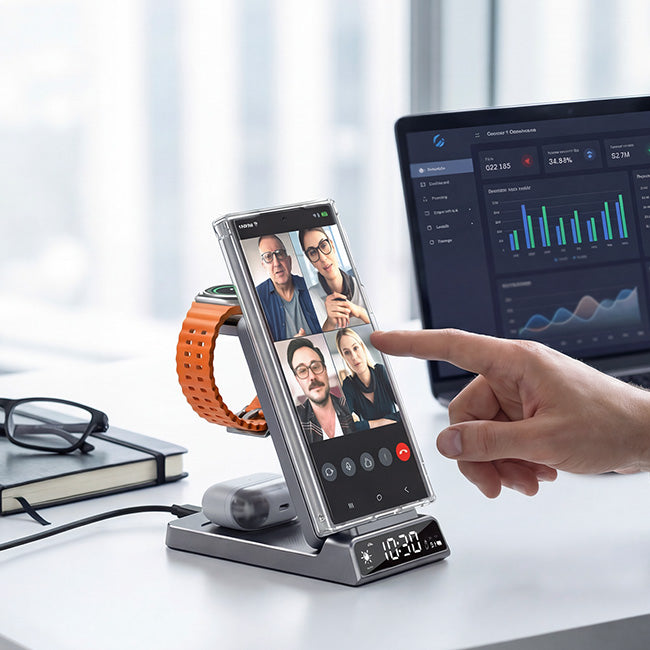
CE19S — Multi-Device Office Station
25W · Apple ecosystem optimized · Video conference ready
View Product →
🎒 Pack Lighter. Charge Smarter.
Explore Elecdov's full range of Qi2.2 certified portable wireless charging solutions.
Shop All Elecdov Products →


